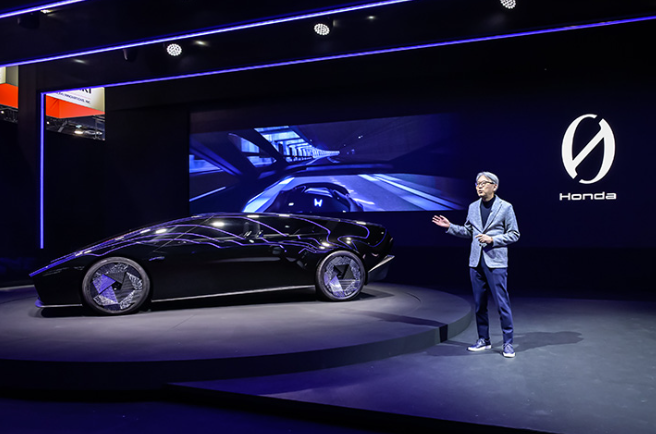

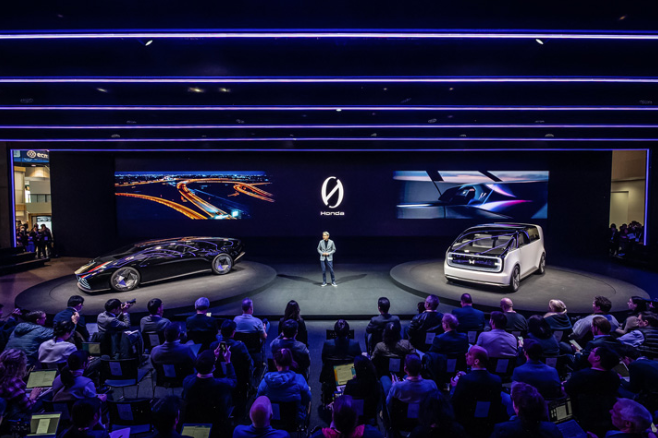
In a groundbreaking announcement at the recent CES convention in Las Vegas, Honda has officially revealed the completion of the design phase for their upcoming line of electric vehicles known as the “0 series.” Currently undergoing rigorous testing at the Honda Headquarters in the United States, these cutting-edge EVs are said to make their debut in 2025.
Leading the line-up in Honda’s 0 series is the Saloon, marking the brand’s definitive entry into the electric automotive landscape. The company confirms its commitment to a global presence, with the European market set to welcome these EVs shortly after their primary release in the United States.


Honda’s European Chief Executive, Katsushia Okuda, emphasized the brand’s innovative approach with the 0 series, describing it as a venture to “create outstanding projects from zero, unconstrained by existing assumptions.” He further elaborated, stating that Honda aims to revisit its roots as an automaker, initiating a fresh start in crafting electric vehicles from scratch—this being the inspiration behind the series’ name.
“Going back to the starting point of Honda as an auto maker and creating new EVs from zero” he says.
Unveiling two models at the CES convention, the flagship saloon stands out as the top of the 0 series, accompanied by the Space-Hub—an intriguing crossover between an SUV and an MPV, prioritizing flexibility and accessibility for diverse consumers. While the production status of the Space-Hub remains unconfirmed, a compact variant is in the pipeline as part of the 0 series.
Toshinobu Minami, Honda’s designer, assured that the saloon’s design, while retaining 90% of its current appearance, might under-go minor adjustments, such as the exclusion of showroom concepts, like the gullwing doors, for practical production purposes. Honda is debating the inclusion of a front LED display, with Minami expressing the brand’s intensions to not make it just decorative; “we don’t want it to be solely for display.”
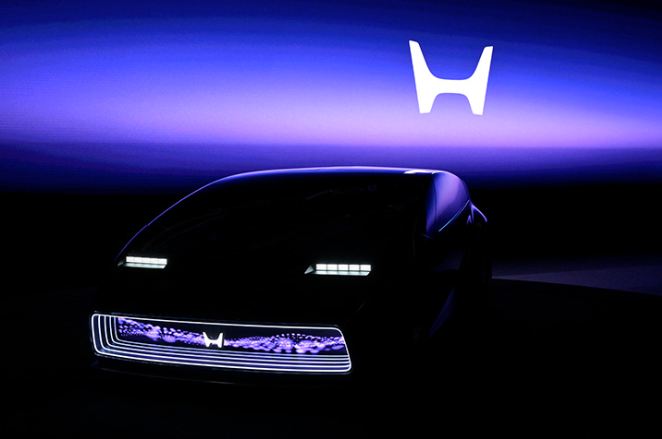
Minami underscored the project’s essence, emphasizing a human-centric design philosophy that signifies a complete re-evaluation of Honda’s approach to automotive design. Despite the sporty stance achieved in the Saloon, Honda insists that it isn’t aiming to compete with other sport EVs but rather pursuing the ultimate functional beauty, with added interior space.
“We try to aim for the ultimate functional beauty and we landed on this sporty design. Giving it more interior space while making it sporty at the same time is difficult, but that is what we are pursuing – and of course we do want it to be sporty.”
“But we’re trying to create the shape of the function while making it emotional.”
Addressing speculations about design inspirations, Honda’s team dismissed any links to previous generations or designs from other brands, clarifying that the 0 series represents a new chapter in the brand’s book. While the external design is deemed production-ready, the interior remains a secret, set for an official unveiling in the near future.

Contrary to replacing existing models, the 0 series acts as a sneak peek into Honda’s future plans, aiming to surpass the limitations of thick and heavy batteries for extended range. Honda’s vision, encapsulated in the moto “Thin, light, and wise,” promises aerodynamic efficiency, aided by a thin floor, and a smaller yet more efficient battery pack. The rumoured charging capabilities range from 10-80% in under 15 minutes. The battery’s capacity remains undisclosed, though we can expect to see ranges starting from 300 miles.
“Honda will strive to create new value for EVs by transcending the constraints of being thick and heavy due to the large and heavy battery necessary to secure long enough range, as well as a large and heavy body and platform necessary to accommodate such batteries.”
AutoCar’s news and feature editor, Felix Page was impressed by these crazy battery statistics. ” I mean, what didn’t they talk about? I think the fact that they managed to make the batteries denser for a better centre of gravity is huge. I really wonder where they will go with their performance EVs next. “
Underlining their commitment to long-term sustainability, Honda sets ambitious goals for their batteries— to maintain 90% usable capacity after a decade of use. Artificial Intelligence finds a place in the 0 series. Honda enabled the vehicle to learn and adapt to the driver’s behaviour for personalized recommendations. This is planned to improve the driving experience, something Honda wants to keep despite the change to electric powertrains. “The more people use their vehicle,” Honda said, “the closer they become with their vehicle.”
“I think both autonomous driving and actual driving are fun,” said Minami. “In autonomous driving, you can relax and enjoy the scenery or conversation with your family, and then when you’re driving, you enjoy the drive.”
“I think both can be achieved, and in order for autonomous driving to be stable, that means the actual character of the vehicle itself needs to be good as well, so we want to make sure that we polish the basic performance of the vehicle so that autonomous driving can happen.”
Despite the grand unveiling, Honda remains secretive on the quantity of vehicles under the 0 series. However, the focus is clear—mid-large EVs, exemplified by the 5-meter saloon showcased at the convention.